A useful food pan request for quotation (RFQ) gives suppliers enough detail to review each SKU and explain what their price includes. It is a request for a reviewed quotation, not a purchase commitment.
Whether you buy for the Middle East, the UK, Europe or North America, identify the target market and destination, then organise the enquiry around individual SKU lines. Keep product specifications separate from packing, sample and commercial requirements so each part can be checked.
Choose the product family
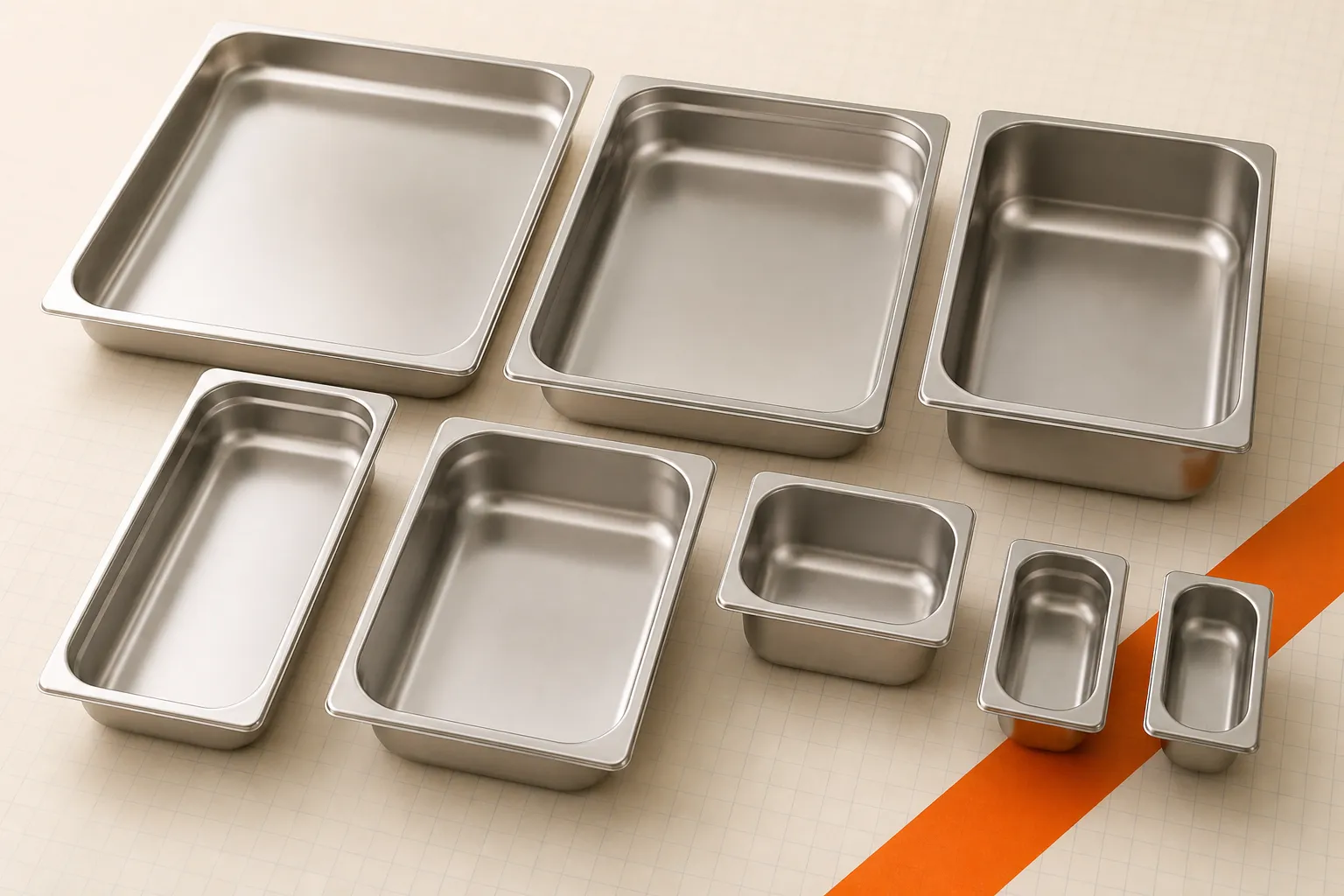
SEEKTAY’s current family labels are European-Style GN Pans (Stepped-Sidewall Series) and American-Style Hotel & Steam Table Pans (Smooth-Sidewall Series). These are product-family labels, not universal regional definitions or proof of equipment fit.
For size terminology and equipment-fit checks, refer to the GN size and depth guide or the hotel pan size and depth guide. A pan’s outside dimensions and an equipment opening are different measurements; record them separately when preparing equipment details.
If the family is uncertain, provide a reference photo, drawing or existing sample, or identify the equipment model, opening measurements and support details.
SS201 and SS304 are options for selected specifications. Confirm size, depth, material, thickness, construction and accessories together as one SKU against the current specification list.
Give each SKU its own enquiry line
Use one line per SKU rather than combining different sizes or depths in one sentence. Mark unknown entries “please advise” so the supplier can distinguish open questions from confirmed requirements.
| Field | What to enter |
|---|---|
| Line | Give each SKU its own line number for quotation and later clarification. |
| System | State the requested family/system, or mark “please advise”. |
| Fraction/ |
Enter the required fraction or size designation. |
| Outside dimensions | State the pan’s overall outside length × width and units, not the equipment opening. |
| Depth | Enter the requested pan depth and units. |
| Material | State the requested material; confirm it is offered for that specification. |
| Thickness | State the required thickness and units, or mark “please advise”. |
| Solid/ |
Specify solid or perforated construction. |
| Lid/ |
State lid and handle requirements; specify anti-jam requirements for the European-style GN family. |
| Qty | Enter the requested quantity in pieces for this SKU. |
Available combinations vary by size, depth, material, thickness and construction. Please request the current specification list.
Download the blank food-pan RFQ template (CSV)
The CSV covers SKU lines only. Send the commercial, packaging, document and sample context described below alongside it; those requirements are not captured by the SKU columns.
Add the commercial context
Give your company name and country, target market of use or resale, destination port or city, and quantities per SKU. Indicate whether the enquiry concerns a sample, trial order or repeat programme.
State the required date and explain what it means: sample preparation, shipment readiness and arrival at destination are different milestones. Ask the supplier to identify which milestone its quoted timing addresses. Label provisional dates clearly.
Request the quotation’s currency, quoted delivery/price basis, transport scope and excluded or separately charged items. These details belong to the specific quotation; they should not be assumed from a previous order or another supplier’s offer.
Separate fixed requirements from choices on which you need advice. This makes proposed alternatives easier to review without losing the original request.
Check the per-SKU minimum and carton mix
SEEKTAY’s MOQ for standard items is 100 pieces per SKU. Mixed sizes and depths are accepted subject to one full master carton per SKU.
Ask for the carton quantity for every SKU before finalising the mix. A quantity entered on an enquiry line is a requested quantity; confirm any adjustment needed to meet the full-carton requirement in the quotation. Check both the 100-piece minimum and the carton requirement for each SKU.
Logo work, private-label packaging and new specifications have separate MOQs. Confirm the applicable minimum for each request rather than assuming the standard-item per-SKU minimum covers every customised element.
Define marking and packing separately
Standard export packing consists of nested products, suitable surface protection and labelled master cartons. Treat additions as separate quotation requests, not automatic inclusions.
For custom marking and packaging, identify the affected SKU and keep each request separate. A label request is not the same scope as a laser mark or a printed retail box.
| Request | What to specify |
|---|---|
| Laser logo | Artwork, proposed position and the SKU requiring the mark. |
| Label | Label content, placement and affected products or packs. |
| Barcode | Required code, format and where it must appear. |
| Private-label carton | Carton wording, artwork and the SKU or assortment it covers. |
| Colour box | Required presentation and artwork for each affected SKU. |
| Pallet | Requested pallet and handling requirements for review. |
| Language | Required language for each label, box or carton. |
| Artwork version | File name, version or date, and which earlier version it replaces. |
| Approval sample/ |
Identify the sample or artwork reference to review before approval. |
Ask the supplier to confirm feasibility, MOQ and approval requirements for each requested element, and to identify related charges. Barcode, private-label carton, colour box and pallet options are subject to MOQ and final approval. Keep the agreed artwork reference with the affected SKU lines so revisions remain clear.
Agree the sample scope and timing
Quotation and sampling follow the reviewed scope. Use the sample request page to identify which SKU and requirements the sample is intended to review, together with its destination.
Stock or existing-specification samples are normally prepared within 3–5 working days after confirmation. Customised samples normally require 7–15 working days after specification, artwork and sample-charge confirmation. Actual timing is confirmed case by case.
These are preparation periods, not arrival or dispatch guarantees. Confirm sample charges and transport separately; the preparation estimate does not imply a free sample or reserve bulk stock.
Define what approval covers: the specified SKU, agreed artwork or packaging reference, and any identified equipment combination. One sample does not approve every SKU or equipment combination. Request bulk-order timing separately against the reviewed order scope.
Identify document requirements by SKU and destination
Which material, food-contact, test or market-entry documents does your company or destination market require?
For each document request, identify the relevant SKU and destination, the subject it covers, and any requested format or language.
SEEKTAY reviews feasibility, scope, cost and time case by case. Include the review outcome in the quotation and keep unconfirmed requirements clearly open. A document request is not confirmation that the document can be supplied.
Compare the same quotation scope
Resolve differences before comparing unit prices. Use this checklist to establish whether quotations cover the same request.
| Quote item | What to compare |
|---|---|
| Family/ |
The same requested family, with alternatives identified separately. |
| Outside dimensions/ |
Matching dimensions, depth and stated units. |
| Material/ |
The same requested material and thickness. |
| Solid/ |
Matching construction, lids and handles. |
| Quantity basis/ |
Quantity per SKU, carton quantity and the resulting order mix. |
| Packing/ |
Standard packing versus requested additions, with artwork versions identified. |
| Sample scope | Which SKU and requirements are covered, with charges and transport stated. |
| Documents | Requested scope, review outcome, cost, timing and any open requirements. |
| Timing | The milestone being quoted and the scope to which it applies. |
| Currency/ |
Currency, quoted price/delivery basis and transport scope. |
| Exclusions/ |
Costs and items outside the quoted unit-price scope. |
Ask for alternatives and unresolved items to be flagged before treating a quotation as comparable. A lower unit price for a different construction, carton basis or packing scope is not a like-for-like comparison.
Keep the quotation tied to the same SKU line numbers and artwork versions used in the enquiry. Where an alternative is proposed, retain the original requirement and record the alternative separately rather than silently replacing it.
Check the enquiry and send
Before sending, check that each SKU has its own line, dimensions have units, unknowns are marked “please advise”, and quantities can be reviewed against full cartons. Include the target market, destination, meaning of the required date, packing changes, sample purpose and document requests with the SKU list.
You do not need to complete every checklist field to make contact. The quote form requires only Name, Email and Inquiry content. Its SKU selector is optional, and you may send a free-text enquiry without completing it. Ask for the current specification list in the same message.
Photos, drawings and spreadsheets follow by email after the initial enquiry, rather than through an on-page upload. Start with the details available and identify what needs advice so the next step is a reviewed, comparable quotation.